Showing posts with label Ruins. Show all posts

Sunday, 22 December 2024

Orthrocaris

Ryl Madol is not just a nightmare for its brave explorers but also for the average taxonomists, whether they study the animals live on the island or preserved in formaldehyde from the safety of their comfy university offices. Evolution has taken its very own unique path here, often with entire groups which are elsewhere only known from fossils. The end result are thus forms and combinations which defy all of our anatomical borders.

One of the most enigmatic of these is little Orthrocaris antebabylonensis, or Insanity Fish, curiously often found swimming within the pools and swamps which form at the center of the ancient, ruined plazas and their flooded sewers. There can be no other way than to simply describe it as a chimaera. At the front, a soft, bivalved, gill-bearing carapace, very much like in a phyllocarid crustacean, gives rise to two segmented arms and a head with two compound-eyes. So far, so arthropod. But then the mouth is ringed by four or more unsegmented little tentacles, very much like in a cephalopod. The hidden mouth itself is a single claw-shaped mandible similar to that of a velvet worm. Behind the carapace then emerges an elongated, eel-like body, with a dorsal and ventral fin running down its length. Though this body is soft, on the inside it contains a stabilizing organ which unmistakably resembles the chorda dorsalis of our own phylum. What can be said of such a creature which wildly mixes traits or arthropods, cephalopods and chordates? It is the invertebrate(?) equivalent of a platypus.

That nobody has been quite able to shoehorn this little monster into any taxonomical drawer is not surprising. Some claim the arthropodal characteristics outweigh the others, arguing that this may be some archaic member of that phylum that simply evolved the other traits through convergent evolution. Others argue that a chorda dorsalis classifies Orthrocaris automatically within the Chordata. The truth may literally lie somewhere in-between. Some have noted a resemblance to the Cambrian organism Nectocaris, which used to be similarly reconstructed as a chordate with the head of a bug. However, these reconstructions have long been deemed erroneous, as better-preserved fossils of the organism instead suggest that Nectocaris looked more like a flattened, two-tentacled squid. The resemblance to old reconstructions may thus only be a coincidence. Others have suggested a possible affinity of Orthrocaris to the Vetulicolia, who did greatly resemble an odd mix of arthropod and chordate. The cladistic placement of Vetulicolia is itself highly debated and no known vetulicolian fossil is known to have possessed limbs or tendrils as Orthrocaris has, so this affinity also remains entirely speculative. Said limbs most resemble the scourges of Cambrian legless arthropods like Leanchoilia. If recent genomic studies turn out to be true and Deuterostomia is indeed not a true group, then Orthrocaris may be the descendant of some unknown basal group of the alternative chordate-protostome clade Centroneuralia. In other words, it could, in a sense, literally be the ancestor of all groups discussed. Perhaps it could even be the result of some hybridisation accident, back in some dark Cambrian days when the genomes of all the phyla were still similar enough for such taxonomic bastards to come into existence.

Regardless of its classification, contact with Orthrocaris should be avoided at all costs unless one is properly protected. Although the organism is only as large as an index finger, the bite of some individuals is lethal. Not because it is venomous. For some unknown reason, the saliva of the organism carries a prion inside it. Prions are misfolded proteins, which can cause other proteins to misfold in the same way, allowing them to pathogenically reproduce almost like viruses. There is no known treatment method for prion diseases, so 100% of all infected end up either dead or severely disabled for life.

Like mad-cow-disease, the Orthrocaris-prion is neurodegenerative, meaning it attacks the human brain. It can lead to insanity, followed eventually by brain-death. Some infected have been reported to have escaped their containment and in a mad rave wandered out into the island, only to return days later, with almost no scratch on their body. The animals on the island (who seem to be immune to the prion) show no interest in attacking infected humans. Most shockingly, those patients who escaped without a protective mask on suffered no ill effects from the island’s toxic spores. It seems almost like a sadistic twist that only this disease grants humans the ability to survive on Ryl Madol, but at the price of a short life of insanity. The Headtakers, never too fond of outsiders, have by now discovered the disease’s cause and effect and weaponized it. Using the snake-like glottis in their lower jaw, Headtakers are capable of using blowpipes. When they are feeling especially sadistic, they will carry a leathern waterbag full with little, living Orthrocaris with them, remove the “fish’s” tiny arms and shoot them through the pipes at the necks of unsuspecting humans.

The most bizarre aspect of the prion is just how it cripples the brain. In most cases it mainly affects the areas responsible for language processing, making the infected eventually incapable of talking in coherent words or sentences. Instead, they all start spouting completely unintelligible gibberish. However, all those infected speak the same gibberish and seem to be able to understand each other to some degree, while suddenly incapable of understanding their healthy colleagues. In the early stages of the disease, before they lose the capability of speech completely, they can be heard in their quarantine cells seemingly conversing with each other in undecipherable but still distinctive words and phrases like “Oadriax!”, “Dilzmo!”, “Cordziz”, “Agtoltorn parach asimp!”, “Pappe hasatan, pappe hasatan aleppe” and “Rahel mai ameche zabi almi”. I imagine this must surely be of interest for neurolinguists, but they have not returned my calls.

Friday, 12 January 2024

Basilosuchus

Click to enlarge

Huge, ferocious and carnivorous, Basilosuchus imperiosus, though rare in its adult form, is a creature feared across the whole island. Here we see it, among the ruins, feeding on a dead Megarhinosaurus, a poor dinocephalian that was probably slain by the giant predator.

Basilosuchus is a bipedal creature, often walking with a horizontally held spine, with prominent armour plates along the back. Its tail ends in a flattened paddle, painted with a prominent spot probably used for social signalling. The three horns on the skull may also serve a similar purpose, though they might also be used for interspecies territorial fights.

Click to enlarge. Life stages are not to scale.

The most fascinating aspect about this creature is its life cycle. Despite appearances, Basilosuchus is not a dinosaur nor even a true reptile. It is an “anamniote”, a reptiliomorph stegocephalian, more closely related to us than to true amphibians, but still outside the Amniota. As such, while it has many reptilian characteristics, it still lays its eggs in water, where they hatch into tiny, gill-bearing tadpoles. While it seems archaic, this has allowed Basilosuchus and many other Rylian anamniotes to evolve a complex life cycle which prevents the juveniles from competing for the same limited resources of the island as the adults.

After the tadpole loses its gills and grows its hindlegs, it turns into a large amphibian with simple armour-plates along the back. This stage strongly resembles creatures from the fossil record known as Chroniosuchia, which may show where the origins of Basilosuchus lie. This stage lives as a crocodile-like ambush-predator in swamps and rivers.

After some time, the hindlegs of the chroniosuchoid grow longer and the limbs are tucked underneath the body. The jaw becomes more crooked and horns start growing on the snout. This new “suchoid” stage leaves the water and starts living inland, especially the cluttered rainforest, where it preys on smaller animals. This stage is morphologically and ecologically perhaps most comparable to one of the extinct land-crocodilians.

With time, the “suchoid” increases in size, the hindlegs become longer, more robust, and it starts walking on them more and more until it becomes fully bipedal and ventures into the open forest galleries and fern prairies. This is generally where adult life begins. But, fascinatingly, depending on environmental conditions, both the chroniosuchoid and suchoid stages can already become reproductively active, at which point they actually remain in this stage for the rest of their life. “Juvenile” Basilosuchus are thus encountered far more often than the ferocious adults and take on their own specific roles in the ecosystems they inhabit.

Wednesday, 10 January 2024

The Silent Ruins and their Anomalies

Ryl Madol was once inhabited, that much is clear. Cyclopean ruins of streets, plazas, houses, temples, pyramids, walls, statues and monoliths are strewn across its entirety. It seems that almost every point of the island was at one point built upon by this ancient race. Perhaps, when it was once part of a far larger landmass, Ryl Madol was but a city-centre at the heart of a much larger empire. 

But however long ago those days must have been, they are now over. Any border between nature and civilization has long since collapsed. The jungle has crept over everything, every dwelling now only houses spiders and infernal centipedes. The works of intelligent forces are turned to rubble each day under the feet of giant beasts.

Who were the people that built these structures? Some architectural similarity suggests a vague link to the cultures of South-East Asia and the Pacific. Especially the art of interweaving columns of volcanic rock to build structures bears an uncanny resemblance to the Polynesian ruins of Nan Madol in Micronesia, which is what has earned the island its name. Just as intriguing are the large stone blocks sanded down into individual shapes in order to fit into each other like pieces of a puzzle. This polygonal style of building can elsewhere only be found in Peruvian sites like Sacsayhuaman, which was built by the Inca.

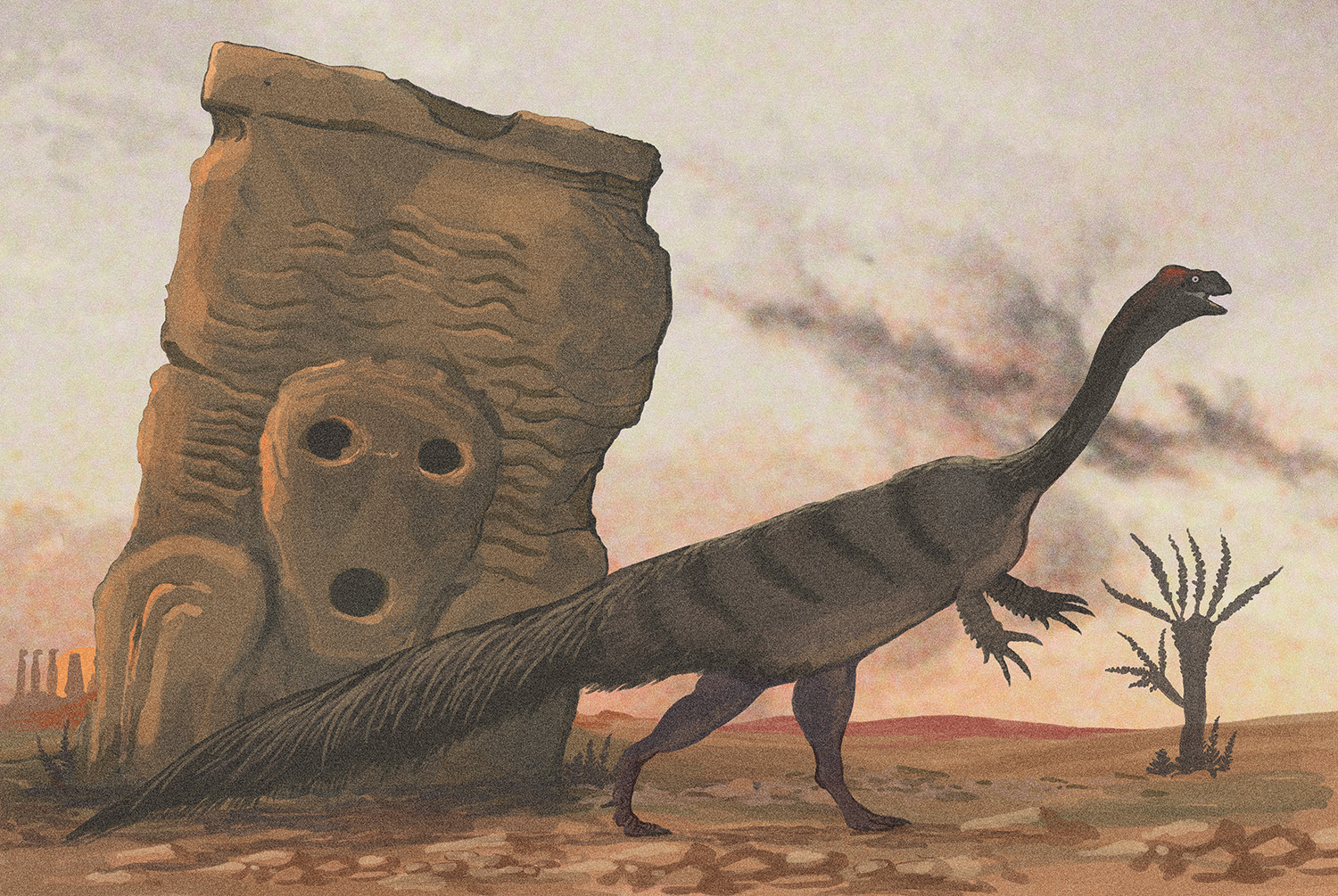
But were the people of Ryl Madol people at all? This is a question that naturally occurs if we take the current intelligent race of the island, the Headtakers, into account. Although these reptilians currently exist in an archaic state, is it not possible that they degenerated from a once far more advanced race which had inhabited the island? It is hard to say. Some of the ruins’ dimensions, especially roofs, doorways and tools, do seem quite inhuman, as if made for and built by entities at least 2.5 metres tall. No corpses, mummies or skeletal remains have ever been found of the vanished race. Were they all devoured by the forces of nature and time? Did they perhaps cremate all of their dead? Their remaining artwork also gives little clue. Clearly, they depicted some of the animals they lived with and (hopefully) mythical monsters, but there are no clear depictions of themselves. Found across the island are large monoliths with the relief of a vaguely humanoid face, which evokes Edvard Munch’s The Scream. Is this what they looked like or just a figure of their mythology? Disturbingly, shortly before he died under mysterious circumstances in the streets of Istanbul, the mad Turkish artist C.M. Kosemen had illustrated just such stone features in his reconstruction of the dinosaur Massospondylus, claiming the inspiration to have come from entities encountered during sleep-paralysis.

The Walls

Most spectacular among the ruins are of course the gigantic walls found in two sections of the island, both standing almost 20 metres tall in some sections. The more intact one is found in the southeastern valley, spanning two mountain ranges in order to shield a river-delta and bay from the remaining island. Likely, this area used to be a city, the wall having functioned to keep the large monsters out. The other great wall in the north-west used to be far longer, but is now broken, many of its sections slowly sinking into the sea. The area it circled may have also been a population centre once, far larger than any others, but the unstable geology of the island has caused this stretch of land to sink beneath the sea. Former hills bearing temples are now heavily fragmented islands jutting above the waves. It is likely this instability which has led to the downfall of the civilization, as frequent earthquakes destroyed their infrastructure and tore down the walls, which could no longer protect the inhabitants from the wild monsters roaming the island.

The architectural style of the walls is markedly different from that of the other ruins. Perhaps this is simply a consequence of mechanics, but it could also suggest that a different culture or even species could have built them before the main civilization arrived on the island.

Anomalies

The most baffling aspect of Ryl Madol are “anomalies”, places or objects on some parts of the island which seem to defy physics. These are largely found underground inside subterranean chambers and catacombs created by the vanished race. Some of these create fields which completely negate the effects of gravity, making things float with no weight. In other sections, gravity is increased tenfold, making for invisible but deadly crushing traps. There are holes and pits which seemingly have no bottoms. Stalkers who accidentally fell into them appeared dead the following days atop random pyramids on the island. Some of the recovered artefacts cause madness and schizophrenia, often leading to suicide or worse. Some catacombs have vats filled with “hell slime”, an unclassified viscous liquid that dissolves any biological matter that falls into them. The entire underground of the island seems to be networked by a labyrinthine maze whose entirety has never been mapped and whose depth seems immeasurable. Stalkers who have gone too deep into it and survived later fathered stillborn children.